Common coagulants
Aluminum sulfate (alum), ferrous sulfate (copperas), ferric sulfate, and ferric chloride.
WETS offers a wide range of filtration solutions for potable and wastewater applications. Over more than 50 years, we have installed or retrofitted hundreds of gravity and pressure filtration systems, developing proprietary features that enhance filter performance and deliver improved water quality.
Filtration removes suspended and colloidal matter from water as it passes through a suitable medium, producing water of sparkling clarity.
Filtration through sand beds has been used for water purification for thousands of years; today’s standard for municipal systems is the dual media filter, using crushed anthracite coal and sand atop a gravel subfill — sometimes referred to as a rapid sand filter.
Dual media sand-anthracite filters are primarily used to remove turbidity and suspended solids as small as 10 to 20 microns, offering efficient particle removal at relatively high filtration rates. State administrative codes typically set specific requirements for filtration systems, including media depth and maximum filtration rates.
While dual media remains the workhorse of water treatment, other filter media have been developed over the years to target specific contaminants more effectively.
Drawing on years of experience with alternate media and our pilot study program, WETS can identify the best filtration solution for your water quality issue. See our Contaminants section for more detail on filtration for these specific applications.
Removing suspended solids in a granular media filter involves a complex set of phenomena, and matching filter selection and design to pretreatment requirements is critical. Because quantitative design theory has had limited success in this area, sound design still relies on experience and practice — which is why a pilot study is typically required.
Much of the objectionable material in water is colloidal in size and won’t be removed by sedimentation or standard filtration alone.
Chemicals called coagulants are used to cause these fine particles to collect into larger, filterable clumps, or floc. Coagulation works by using positively charged metal ions to attract the negatively charged colloidal particles that would otherwise repel one another (nearly all suspended particles in natural water carry a negative charge).
Coagulation is affected by a number of factors — pH, salt concentration, temperature, coagulant type, and turbidity among them — so achieving effective coagulation for any particular water can be challenging. Coagulant aids improve floc properties for filtration, making it more durable or faster-settling. For these reasons, jar testing and field pilot testing are often necessary to determine the best approach to coagulation and solids removal.
Aluminum sulfate (alum), ferrous sulfate (copperas), ferric sulfate, and ferric chloride.
Anionic and non-ionic polymers, sodium silicate, bentonite, and calcium carbonate.
Over time, filter media becomes plugged with solids and precipitates, signaled by rising headloss on the filter gauge. At that point, flow is reversed to backwash the media.
Backwashing expands the bed by 30–50% to carry off lighter floc and foreign matter while allowing sand particles to scour one another. Backwash water must be clean, filtered water, sourced from parallel filter units or storage.
For smaller municipal or utility systems, backwashing is typically a manual operation; some systems are fully automated, initiating on a set schedule (often weekly). Ineffective backwash allows filter media to become permanently fouled, eventually requiring replacement — which is why several techniques have been developed to improve backwash performance.
The simplest and most common method. Filter flow is reversed and clean water is pumped through the media at relatively high rates, ideally expanding the bed 30–50% to carry particulates out of the filter.
Rotating sweep arms spray water at high velocity across the media surface during backwash, causing media grains to collide and dislodge trapped contaminants. Benefits include preventing mudball formation, cracking, and cementation, and extending filter run length.
Originally developed for the wastewater market, air scour reduces the energy needed to fluidize media and lowers backwash water use and rate. Air is introduced below the media and rises through it, creating high-energy contact between media grains that significantly improves contaminant removal compared with water-only or surface-wash methods alone.
Backwash rate is lower when surface washing is employed, and can be optimized using core samples taken before and after backwash — too low a rate under-cleans the bed, while too high a rate disrupts it and reduces performance.
Sub-optimal backwash can lead to mudballs — spherical aggregates of solid material, typically about an inch in diameter, that form near the sand surface and gradually sink if left unaddressed. Surface washing helps prevent their formation, and properly designed collection troughs support prompt wastewater removal and further reduce mudball risk.
The underdrain serves two key functions.
It uniformly collects filtered water to maintain a constant filtration rate and directs it to the filter outlet.
Even more critically, it evenly distributes backwash water so the gravel subfill remains undisturbed and the filter media expands uniformly.
The WETS proprietary underdrain is a simple design that delivers better performance and longer filter bed life than the more expensive, complex designs offered by established filter vendors.
WETS builds two basic filter types: the pressure filter, an ASME pressure vessel typically constructed of low-carbon steel, and the gravity filter, typically an ambient-pressure fiberglass vessel.
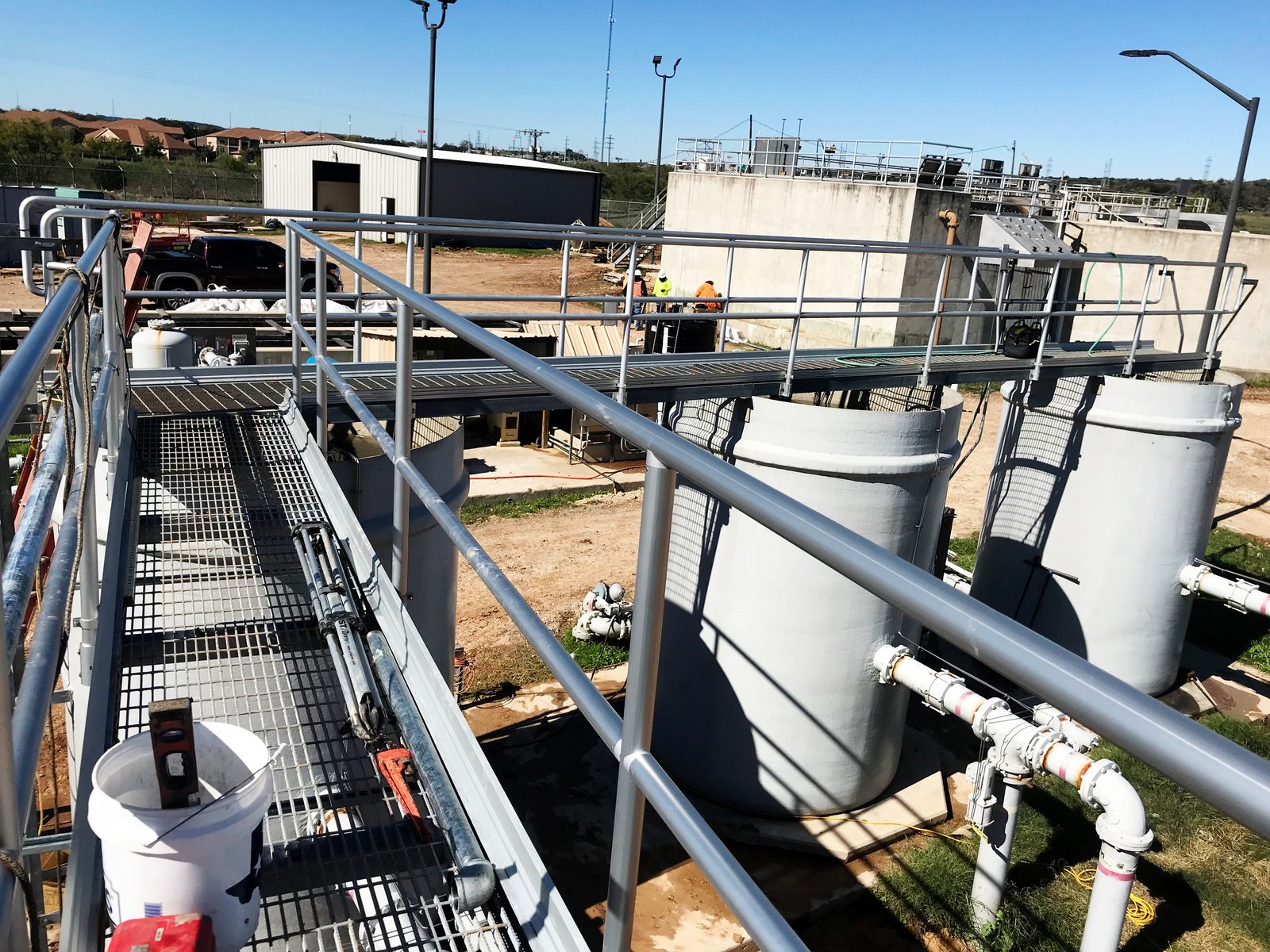
In a typical gravity filtration system, water is fed from the wellhead pump to an elevated aerator, then flows by gravity through ground-mounted filters before being pumped to the GST or holding tank.
Gravity filters may be cylindrical or rectangular, with very large-capacity systems often built as long rectangular vessels in concrete or steel plate, depending on project specifications and local costs and conditions.
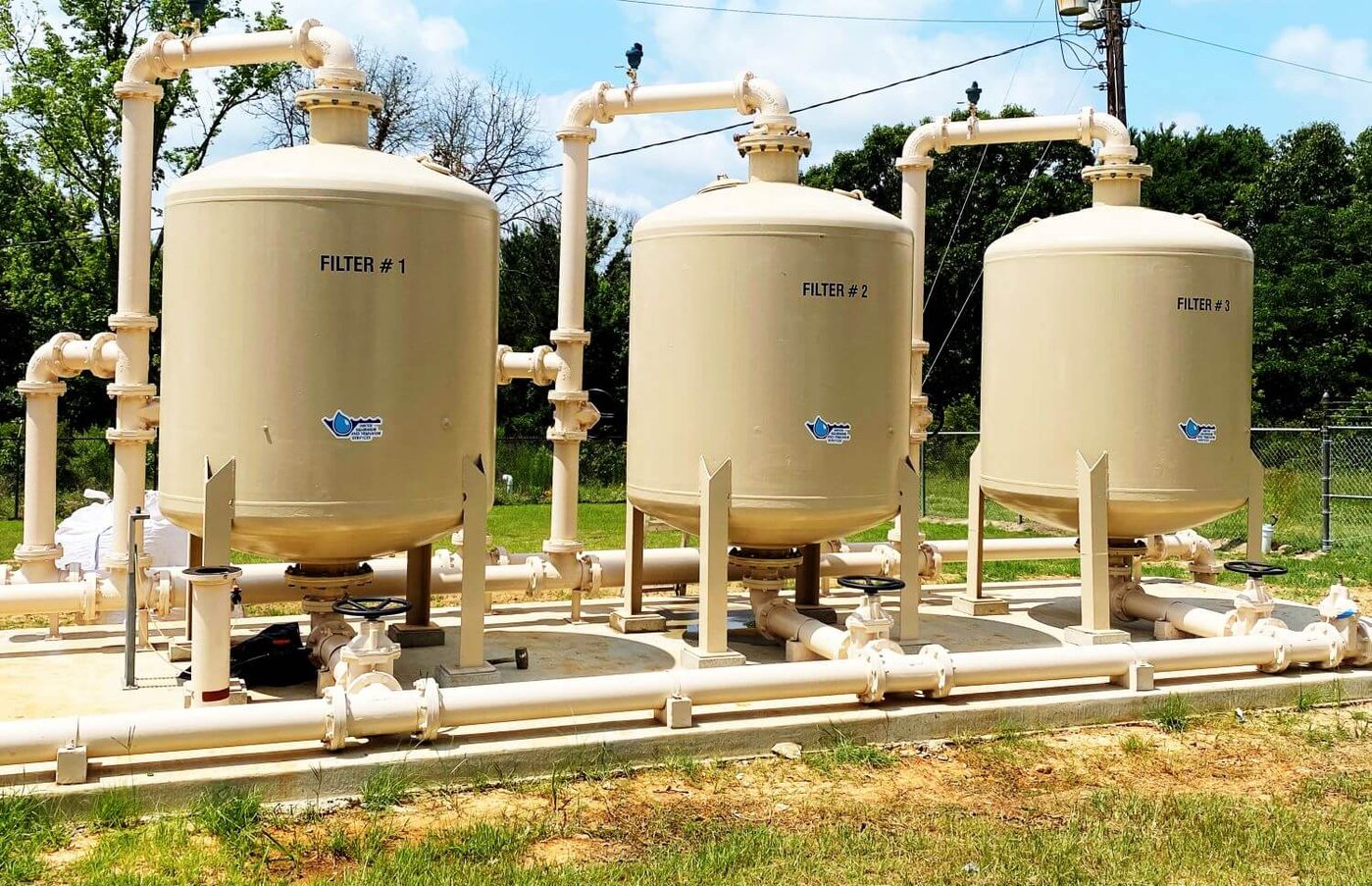
Pressure filters are typically used where aeration isn’t required, allowing the system to remain under pressure from the wellhead pump through to the GST or distribution system. These are ASME pressure vessels, typically constructed of low-carbon steel.
WETS offers vertical or horizontal configurations sized to the available footprint — vertical filters suit smaller flows and buildings with higher headroom but a compact footprint, while horizontal filters handle greater capacity but require more careful backwash design.
Our approach to filtration ensures superior performance at low operational cost.
Contact Us